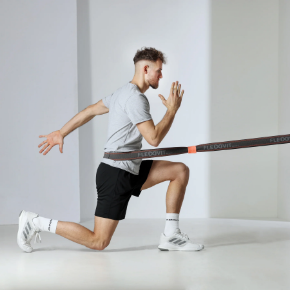
Powerful and approximately 4–7 times thicker compared to a regular exercise band.
Why is the Flossband used?
Through various application techniques, the band applies compression to the muscles. The high fixation pressure creates an inhibitory effect on pain receptors and the underlying fascia, helping to release adhesions and fibrotic areas. This process takes place during active and passive movements of the limb on which the band is applied.
When the band is released, the temporary accumulation of fluid or blood (“stasis”) ends, and fresh blood rehydrates the tissue (the so-called “sponge technique”). This leads to relief from various types of pain.
When is the Flossband used?
Flossband can be used preventively before and after sports activity. It is also a valuable therapeutic tool in physiotherapy. The therapist uses it when pain limits the patient’s or athlete’s movement.
Flossband improves the body's energy transmission pathways: it generates more strength within the tissue, enhances viscoelasticity, and requires less energy for mobility due to axial transmission. As pain decreases, patients and athletes can move significantly better and faster.
Why are there 4 different resistance levels for flossbands?
The set, developed together with renowned sports physiotherapist Sven Kruse, includes 4 different resistance levels. These allow for specific application intensities to stimulate the deeper layers of tissue in a differentiated manner. This enables the therapist to provide precise and appropriate treatment.
The 4 levels also take into account differences in patient tolerance.
Main benefits
-
Tight wrapping / compression on joints and muscles
-
Fixation pressure on pain receptors and fascia
-
Preventive use and for acute phases
-
Specific application levels thanks to the 4 resistance grades
-
Positive effect on joint structure, fascia and receptors
Resistance level:
• Level 4: Very strong – grey – 1.8 mm
Recommended for individuals with high muscle mass; ideal for regeneration therapy.
.png "Recosport Ireland")


























.png)


